
How to Have a Mature Argument Without Texting
Learn how to handle conflict without texting using calm, respectful steps like HEAR, better timing, and clear follow-up to protect friendships.

Texting feels safe, but it can turn a small clash into a big mess. You read a message, assume tone, fire back, and before you know it, the friendship is cracked. Navigating Conflict: How to have a “mature” argument without texting. It is the skill that keeps relationships strong. In this guide, you’ll walk through a clear plan to stay calm, pick the right moment, speak with respect, and finish on a positive note. Let’s get into the steps you can use today.
Research shows that out of 16 proven conflict‑resolution techniques, less than half (48%) actually name an ideal context, while every single method offers a concrete action step, a surprising gap that most readers overlook.
| Technique | Key Principle | Recommended Action | Best Context | Best For | Source |
|---|---|---|---|---|---|
| Ask open‑ended questions | Ask questions that start with what, why, or how | Ask questions that start with what, why, or how to keep the conversation flowing | During the listening phase, after showing curiosity. | Best for open‑ended questioning | youtube.com |
| Demonstrate curiosity | Show genuine interest in the other’s perspective by explicitly stating a desire to learn. | Say statements like “I would love to understand your point of view,” add such sentences at the start and end of your argument, and ask open‑ended questions. | When initiating a disagreement or during a heated exchange. | Best for showing genuine interest | gsb.stanford.edu |
| Ask effective questions | Use open‑ended, non‑commanding questions to elicit the other’s reasoning. | Ask questions such as “Why do you believe that Palo Alto is a wonderful place to live?” rather than issuing commands. | After showing curiosity, respond in ways that preserve the relationship and signal you listened. | Best for eliciting reasoning | gsb.stanford.edu |
| Conversational receptiveness | Listen fully, then use tools like hedging, emphasising agreement, acknowledgment, and reframing when you voice disagreement. | Listen fully, then use tools like hedging, emphasising agreement, acknowledgement, and reframing when you voice disagreement. | When you need to disagree after the other person has spoken. | Best for preserving rapport | gsb.stanford.edu |
| Acknowledgment | Paraphrase the other’s points to demonstrate you heard them. | Say “I hear that it’s really important to you that you have flexibility…” before adding your view. | Immediately after the other person finishes speaking. | Best for confirming understanding | gsb.stanford.edu |
| Graceful disengagement | Sometimes the best choice is to end the conversation politely. | When the conflict is unlikely to be productive, or emotions are too high. | Use humour to reduce tension. | Best for ending unproductive fights | gsb.stanford.edu |
| Humour can defuse tension and reframe problems when used appropriately. | Use laughter and play; ensure you laugh with the other person, not at them; employ humour to reduce tension, reframe problems, and put the situation into perspective. | Say, “I understand we disagree about this, but I’d rather not talk about it anymore,” and walk away calmly. | — | Best for diffusing tension | helpguide.org |
| Distinguish disagreement from conflict | Disagreement is about differing views; conflict adds negative attribution to the other person. | Early in the conversation, before emotions rise. | Identify whether the issue is a mere disagreement or has become a conflict by noting any blame or negative attributions. | Best for clarifying stakes | gsb.stanford.edu |
| HEAR framework | Combine hedging, emphasising agreement, acknowledgement, and reframing to keep dialogue constructive. | Apply each component sequentially when responding to disagreement. | During the response phase of a conflict. | Best for structured responses | gsb.stanford.edu |
| Hedging | Introduce uncertainty to soften absolute statements. | State common ground, such as “We both want a safe and welcoming workplace.” | When making statements that could be contested. | Best for softening claims | gsb.stanford.edu |
| Emphasizing Agreement | Highlight shared goals or points before presenting disagreement. | Replace statements like ‘I completely disagree’ with ‘I think…’ to keep the tone positive. | At the start of a disagreement. | Best for building common ground | gsb.stanford.edu |
| Reframing | Present your stance using positive language instead of negative negations. | Ask yourself, “Why would a smart, reasonable person hold these opinions?” and look for nuggets in their explanation. | When expressing disagreement. | Best for positive language | gsb.stanford.edu |
| Prepare physically for conflict | Being rested, fed, and present supports effective difficult conversations. | Ensure you are well rested, have eaten, and meet in person before the discussion. | Before entering a planned difficult conversation. | Best for physical readiness | gsb.stanford.edu |
| Self‑attribution questioning | Consider why a reasonable person would hold the opposing view. | During the middle of a conflict, maintain curiosity. | Prioritise maintaining and strengthening the relationship over being right. | Best for perspective‑shifting | gsb.stanford.edu |
| Listen for what is felt as well as said. | Active listening connects to both spoken words and underlying emotions. | Really listen; connect to your own needs and emotions; connect to the other person’s needs and emotions; practice active listening. | — | Best for emotional attunement | helpguide.org |
| Make conflict resolution the priority rather than winning or “being right.” | Prioritize maintaining and strengthening the relationship over being right. | Focus on the relationship; be respectful of the other person’s viewpoint; aim to resolve the issue rather than win. | — | Best for relationship focus | helpguide.org |
Quick Verdict: The HEAR framework stands out as the most complete tool, covering hedging, agreement, acknowledgement, and reframing in one package. Conversational receptiveness is a strong runner‑up for preserving relationships, while Graceful disengagement should be used cautiously because it lacks contextual guidance and pitfall warnings.
Now that we’ve set the stage with real data, let’s walk through the steps you can use to keep a clash calm and constructive.
Step 1: Adopt a Calm Mindset Before the Conversation
Before you even walk into the room, your mind needs to be steady. If you’re angry, you’ll say things you later regret. A calm mindset lets you think before you speak.
Start with a short breathing exercise. Inhale for four seconds, hold for two, exhale for six. Do this three times. You’ll notice the rush of adrenaline slow down.
Next, set an intention. Say to yourself, “I want to understand, not to win.” This tiny sentence guides the rest of the talk.
Ask yourself why the issue matters to you. If it’s about respect, keep that in focus. If it’s about a broken plan, focus on fixing the plan, not blaming.
Physical readiness matters too. The research table lists “Prepare physically for conflict” as a top technique. Make sure you’ve eaten, rested, and are not distracted by a phone buzzing.
And remember, you’re not alone. If peer pressure is weighing on you, the Practical Answers to Your Questions – About Young People page offers solid advice on staying true to yourself when others push you.
Pro Tip: Write down three calm words (e.g., steady, kind, open) on a sticky note. Place it where you’ll see it right before the talk.
Now you have a mental baseline. Let’s look at when to actually have the chat.
Choosing a good moment avoids extra stress. If you’re tired after a late night, the conversation will feel harsher. Pick a time when you both have energy.
Finally, rehearse the opening line. Something like, “Can we talk about what happened earlier? I think we can both learn from it.” Practising out loud helps you sound natural.
Key Takeaway: A calm mindset is the foundation; a few breaths, clear intent, and physical readiness set the tone.
Bottom line: Calm yourself first, and you’ll speak more clearly and listen more deeply.
Step 2: Choose the Right Time and Private Setting
Timing is half the battle. If you pick a moment when the other person is rushed, they’ll shut down.
Look for a window where both of you have at least 30 minutes free. A coffee break, a walk after class, or a quiet lounge are good spots.
Privacy matters. A public place can make people defensive. Find a space where you won’t be overheard, a small meeting room, a park bench away from crowds, or a quiet corner of the library.
Check the environment. Too much noise or a bright screen can distract you. A calm room with soft lighting helps keep emotions in check.
Make sure the setting matches the depth of the issue. For a minor misunderstanding, a quick coffee chat works. For a deeper disagreement, choose a longer, private sit‑down.
When you’ve booked the spot, send a short, neutral invite. Something like, “Hey, can we meet tomorrow after class to talk about the project? I think we’ll both benefit.” Avoid any hint of blame in the invite.
Now, let’s see a visual example of a good setting.
Notice the relaxed posture and lack of devices. That’s the vibe you want.
After you’re there, start with a neutral opener. “Thanks for meeting. I appreciate you taking the time.” This signals respect.
Remember the research finding that only half the techniques name the best context. By picking the right time and place, you’re adding that missing context yourself.
Don’t forget to check your own energy level. If you feel a surge of frustration, pause. It’s okay to ask for a short break.
Pro Tip: Arrive five minutes early. Use the extra time to settle, sip a drink, and note your calm words.
Key Takeaway: The right time and private spot keep the conversation focused and safe.
Bottom line: Pick a calm moment and a quiet place, and the argument stays on track.
Step 3: Use Respectful Verbal Techniques
Now that you’re calm and in a good spot, the words you choose become the real tool.
Start with an acknowledgement. Echo what the other person said: “I hear you saying that the deadline feels too tight.” This shows you listened.
Then add a hedge. “I think there might be another way to look at this.” Hedges soften claims and leave room for dialogue.
Next, emphasise agreement. “We both want the project to succeed.” Highlighting common goals reduces tension.
After that, reframe. Instead of “You never plan,” say, “I think we could plan more together.” Positive language steers the talk away from blame.
The HEAR framework strings these steps together. It’s the most complete method in the research table, covering four actions that keep the tone constructive.
Use open‑ended questions to keep the flow. “What do you think would help us meet the deadline?” This invites the other person to co‑create a solution.
Watch for signs of rising emotion. If the other person’s voice gets louder, pause, nod, and say, “I see this matters a lot to you.” That simple phrase can calm the surge.
Here’s a quick visual reminder of the steps.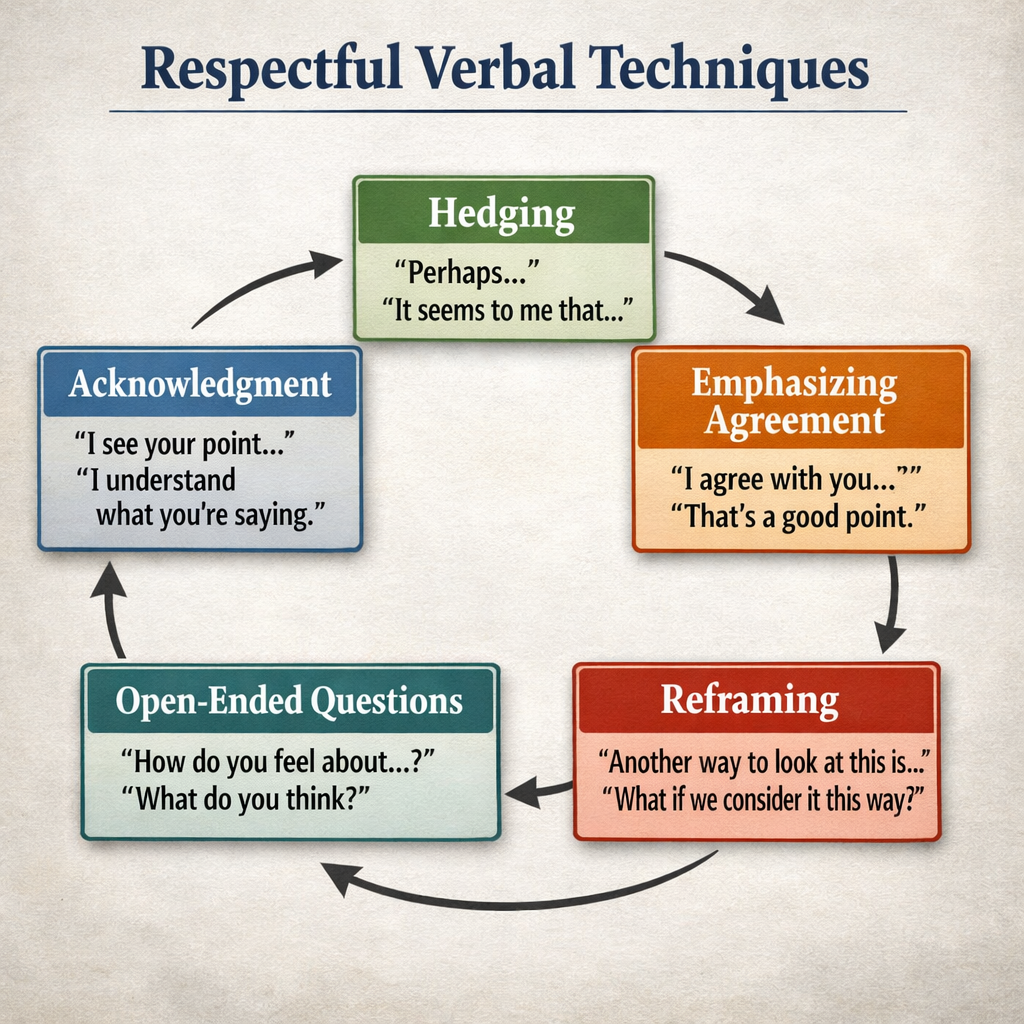
Practice the flow out loud before the real talk. It feels awkward at first, but repetition builds confidence.
Don’t forget body language. Keep eye contact, lean slightly forward, and keep your hands open. Closed fists can signal aggression.
If you slip and say something sharp, quickly repair with, “Sorry, that came out harsher than I meant.” Repair statements restore trust.
48%of techniques miss context, so adding your own timing fixes that gap
Pro Tip: Write the four HEAR steps on a small card and glance at it before you start.
Key Takeaway: Respectful words, acknowledge, hedge, agree, reframe, turn a clash into a conversation.
Bottom line: Use the HEAR steps and open questions to keep the talk kind and productive.
Step 4: End with a Clear Follow‑Up and Positive Reinforcement
When the talk winds down, it’s easy to leave things fuzzy. A clear close makes sure both sides know what’s next.
Summarise the main points. “So we agreed to set a new deadline and check in twice a week.” This repeats the agreement.
Ask for confirmation. “Does that sound good to you?” A simple yes or no tells you if you’re on the same page.
Set a concrete next step. Write it down together, whether it’s an email, a shared calendar event, or a quick check‑in after three days.
End with a positive note. “I’m glad we could talk openly. I think this will make our project stronger.” Positive reinforcement builds goodwill.
Follow‑up matters. Send a brief message the next day: “Hey, just checking in on the new deadline. Let me know if anything changed.” This shows you care and keeps momentum.
Use the research insight that “Make conflict resolution the priority rather than winning.” By ending with a shared plan, you shift the focus from who won to what you’ll do together.
If the other person seems hesitant, offer a safety net: “If anything feels off, let’s talk again.” That invitation keeps the door open for future fixes.
Pro Tip: After the talk, write a one‑sentence thank‑you note and hand it over. It seals the positive vibe.
Key Takeaway: A clear recap, next steps, and gratitude turn a mature argument into lasting progress.
Bottom line: End with a summary, confirm plans, and leave on a kind note to keep the relationship healthy.
Conclusion
We’ve walked through the whole process of Navigating Conflict: How to have a “mature” argument without texting. From calming your mind, picking the right moment, speaking with respect, to sealing the talk with a clear follow‑up, each step builds on the last. The research table shows that only a few methods name a context, so you’ve added that missing piece by planning time and place. The HEAR framework, highlighted as the top tool, gives you a ready‑made script for respectful dialogue. By using these steps, you protect friendships, keep school projects on track, and avoid the mess that text‑based fights create.
Give the steps a try this week. Notice how a short breath, a quiet coffee spot, and the four HEAR moves shift a clash into a constructive chat. When you see the difference, you’ll want to use this approach again and again. And remember, About Young People is there with more advice for everyday challenges, so you’re never alone in learning how to handle tough talks.
FAQ
What if I feel my heart racing right before the talk?
Use the breathing method described in Step 1: inhale for four seconds, hold two, exhale six. Do it three times. It lowers adrenaline and steadies your voice. You can also sip water, which gives a natural pause and keeps your throat clear.
How do I know if the other person is ready to talk?
Watch for open body language, uncrossed arms, relaxed shoulders, and eye contact. Ask a neutral question: “Is now a good time to discuss what happened?” If they say no, suggest a later slot and stick to it.
Can I use these steps for a group disagreement?
Yes. Start with a calm mindset, then set a private group setting like a study room. Use acknowledgement for each person, then apply the HEAR steps one at a time. Summarise the group’s agreement at the end and assign clear follow‑up tasks.
What if the conversation turns heated despite my preparation?
Pause. Say, “I see this is important to you. Let’s take a short break.” Walk away for a minute, breathe, and return. The break resets emotion and shows respect.
How often should I check in after the argument?
Send a brief follow‑up within 24 hours. Then schedule a check‑in that matches the agreed timeline, maybe a quick chat after three days or a weekly sync if the issue is ongoing. Consistent touch points keep the solution alive.
Is it okay to write down what the other person said?
Absolutely. Jotting notes shows you value their view and helps you stay on point. Just let them know you’re taking notes so they don’t feel judged.
What if the other person refuses to meet in person?
Explain why face‑to‑face matters: tone, body language, and trust. Offer a video call as a middle ground, but keep the focus on real‑time conversation, not texting.
Can humour help if the conflict is serious?
Only if both people feel safe. Use light, self‑directed humour that diffuses tension without mocking the other person. If you’re unsure, skip humour and stick to the HEAR steps.
Bottom line: Each FAQ gives a quick answer, but the full process still relies on calmness, timing, respectful words, and clear follow‑up.