
Is Leadership Born or Made? The Science-Backed Answer to an Age-Old Debate
Discover whether leadership is born or made through scientific research, real-world examples, and practical insights for developing your leadership potential.
Ever wondered why some people seem to command attention the moment they walk into a room, while others struggle to get heard in a group project? The question “Is leadership born or made?” has sparked debates in classrooms, boardrooms, and research labs for decades. We examined five leading studies on leadership genetics and discovered that even the most recent research still attributes roughly 30% of leadership ability to innate factors—contradicting the popular belief that leaders are made.
| Name | Year | Key Finding | Source |
| Genetics and Organizational Behavior | 2006 | Genetic factors account for roughly 30% of variance in leadership role occupancy, indicating innate influence. | sagaleadership.com |
| Nature vs nurture: Are leaders born or made? A behavior genetic investigation of leadership style | 1999 | Genetic factors explain a substantial portion of leadership style variance, indicating a strong innate component. | sagaleadership.com |
| Are Leaders Born or Made? | — | Executives are divided, but the authors conclude that leadership is primarily developed rather than innate. | ccl.org |
| Genetics, leadership position, and well-being: An investigation with a large-scale GWAS | — | Large‑scale GWAS suggests about 30% heritability for leadership role occupancy, supporting innate influences. | sagaleadership.com |
| Born to Lead? A Twin Design and Genetic Association Study of Leadership Role Occupancy | — | Twin study estimates leadership role occupancy heritability at 24%, highlighting genetic contribution. | sagaleadership.com |
In this guide, you’ll discover what cutting‑edge science reveals about genetic leadership traits, how the environment shapes leadership skills, and practical ways to develop your own leadership abilities. We’ll explore real‑world examples from history and examine why the modern consensus points to both nature and nurture playing crucial roles.
The Natural Born Leader: What Science Says About Genetic Traits
When researchers ask “Is leadership born or made?”, they often turn to genetics first. The evidence is surprisingly clear: some people do inherit traits that make leadership more likely. But what exactly are these traits, and how much do they really matter?
A groundbreaking study from University College London identified a specific DNA sequence, rs4950, that appears to be linked to leadership ability. Using data from 4,000 individuals, researchers found that people with this genotype were significantly more likely to occupy supervisory roles in the workplace. This was the first study to pinpoint a specific genetic marker associated with leadership behavior.

The research shows that roughly 25% of leadership behavior can be explained by genes passed down from parents. Think about what this means for a college student wondering about their leadership potential. If your parents were natural organizers or took charge in group situations, you might have inherited some of those tendencies.
But genetics isn’t just about one magic gene. The traits that contribute to natural leadership include:
- Extraversion: The tendency to be outgoing and energized by social interaction
- Confidence: A natural comfort with taking risks and making decisions
- Social intelligence: An intuitive understanding of group dynamics and what motivates people
- Emotional regulation: The ability to stay calm under pressure and manage stress effectively
Here’s where it gets interesting for young people. These genetic predispositions don’t guarantee leadership success. They’re more like raw materials that need the right environment to develop. A naturally extroverted person might become a great leader in one setting but struggle in another that requires different skills.
The University College London research also revealed something crucial: even people with the rs4950 genotype still needed to develop their skills through experience and training. The genetic advantage was real, but it wasn’t everything.
For Gen Z students and young professionals, this research offers both hope and realism. If you don’t feel like a “natural” leader, you’re not doomed. The 75% of leadership ability that isn’t genetic can absolutely be developed through practice, mentorship, and the right opportunities.
Consider this practical approach: instead of asking whether you’re born to lead, ask what natural strengths you can build on. Maybe you’re naturally good at listening to others, or you stay calm when everyone else panics. These traits, even if they seem small, can become the foundation for strong leadership skills.
The science also suggests that genetic traits interact with the environment in complex ways. A person with natural leadership genetics might never develop those abilities without the right challenges and support. Meanwhile, someone without those genetic advantages might become an exceptional leader through determination and skill development.
Environmental Factors That Shape Leadership Skills
While genetics provides the starting point, environment often determines whether leadership potential actually develops. The question “Is leadership born or made?” becomes much more complex when you consider how family, culture, and early experiences shape who we become as leaders.
Your first leadership lessons don’t happen in a boardroom or classroom. They happen at home. The parent‑child relationship serves as one of the earliest environments where authority, responsibility, and influence intersect. Children learn how power operates in close relationships by watching how their parents make decisions, handle conflict, and respond to stress.
Think about it this way: before you ever studied leadership theories, you were already experiencing leadership firsthand. You learned whether authority feels safe or threatening, whether decisions are made collaboratively or unilaterally, and whether mistakes lead to learning or punishment.
Research from leadership development experts shows that children are constantly gathering information about their environment. They notice who follows through on promises, who listens without rushing to judgment, and who remains steady when things get difficult. These early observations become reference points for their own leadership style later in life.
The family environment teaches crucial leadership lessons through daily interactions:
- Decision‑making patterns: How choices are made and communicated
- Conflict resolution: Whether disagreements lead to growth or withdrawal
- Emotional regulation: How stress and pressure are managed
- Accountability: Whether mistakes are paired with learning or shame
But family is just one piece of the environmental puzzle. School experiences, peer relationships, and cultural context all contribute to leadership development. A student who grows up in a culture that values collective decision‑making will develop different leadership instincts than someone from a more hierarchical background.
For college students wondering about their leadership potential, understanding their environmental influences can be incredibly valuable. Building self‑confidence often starts with recognizing the patterns you learned early and deciding which ones serve you well as an adult.
Consider the story of a student who grew up in a household where every family decision was discussed openly. This person might naturally gravitate toward collaborative leadership styles, seeking input from team members before making choices. In contrast, someone who experienced more authoritarian parenting might initially feel more comfortable with top‑down decision‑making.
The research on parenting and leadership reveals that children don’t just absorb leadership lessons passively. They actively interpret what they see, adapting their behavior based on what feels safe and effective in their environment.
Here’s what this means for young people today: your early environment influenced your leadership instincts, but it doesn’t determine your future leadership potential. By understanding these influences, you can consciously choose which patterns to keep and which to modify.
Environmental factors continue shaping leadership development well beyond childhood. College experiences, internships, volunteer work, and early career opportunities all provide chances to practice and refine leadership skills. The key is recognizing these opportunities and approaching them with intentional learning in mind.
Learning Leadership: How Skills Can Be Developed and Mastered
The most encouraging news about the “Is leadership born or made?” debate is that leadership skills can absolutely be learned and developed. While some people might start with genetic advantages, anyone can build the competencies that make great leaders through deliberate practice and the right developmental approaches.
Modern leadership development recognizes that effective leaders aren’t just born with charisma and confidence. They develop specific, learnable skills through coaching, mentoring, and structured practice. The key is understanding which development methods work best for different situations and learning styles.
Two powerful approaches dominate leadership development today: coaching and mentoring. While they’re often confused, they serve different purposes and offer unique benefits for aspiring leaders.
Mentoring involves learning from someone more experienced who shares knowledge, insights, and practical strategies based on their own journey. A mentor acts as a trusted advisor, helping you navigate specific challenges and understand organizational dynamics. This approach works especially well when you need industry‑specific knowledge or want to learn from someone who’s successfully traveled a similar path.
Coaching takes a different approach. Instead of providing answers, coaches help you discover solutions within yourself through powerful questioning and reflection. This method develops self‑awareness, critical thinking, and the ability to adapt to new situations. Coaching is particularly valuable when facing complex, ambiguous challenges where there’s no clear playbook to follow.
| Development Method | Best For | Key Benefits | Time Investment |
| Mentoring | Industry knowledge, career guidance | Direct advice, networking, practical tips | 1‑2 hours monthly |
| Coaching | Self‑discovery, complex challenges | Self‑awareness, adaptability, confidence | 1 hour weekly |
| Formal Training | Specific skills, frameworks | Structured learning, credentials | Days to weeks |
| Experiential Learning | Real‑world application | Practical experience, immediate feedback | Ongoing |
The research on coaching and mentoring shows that the most effective leaders often benefit from both approaches. They might work with a coach to develop self‑awareness and strategic thinking while also learning from mentors who provide industry‑specific guidance.
For college students and young professionals, practical leadership development might look like:
- Seeking feedback actively: Ask professors, supervisors, and peers for specific input on your leadership behaviors
- Taking on stretch assignments: Volunteer for projects that push you slightly outside your comfort zone
- Practicing in low‑stakes environments: Lead study groups, organize social events, or coordinate volunteer activities
- Reflecting on experiences: Keep a leadership journal to track what you learn from each opportunity
One of the most powerful aspects of learned leadership is that it can be tailored to your natural strengths and preferences. An introverted person might develop a thoughtful, collaborative leadership style that’s very different from an extrovert’s approach, but equally effective.
The key insight from modern leadership development is that great leaders aren’t born with a complete skill set. They develop competencies over time through intentional practice, feedback, and reflection. This means that anyone willing to invest in their development can become an effective leader, regardless of their starting point.
Real-World Examples: Leaders Who Prove Both Sides of the Debate
History provides compelling evidence for both sides of the “is leadership born or made?” debate. Some leaders displayed remarkable abilities from an early age, while others developed their skills through training, experience, and persistence. Examining these real‑world examples helps us understand how both nature and nurture contribute to exceptional leadership.
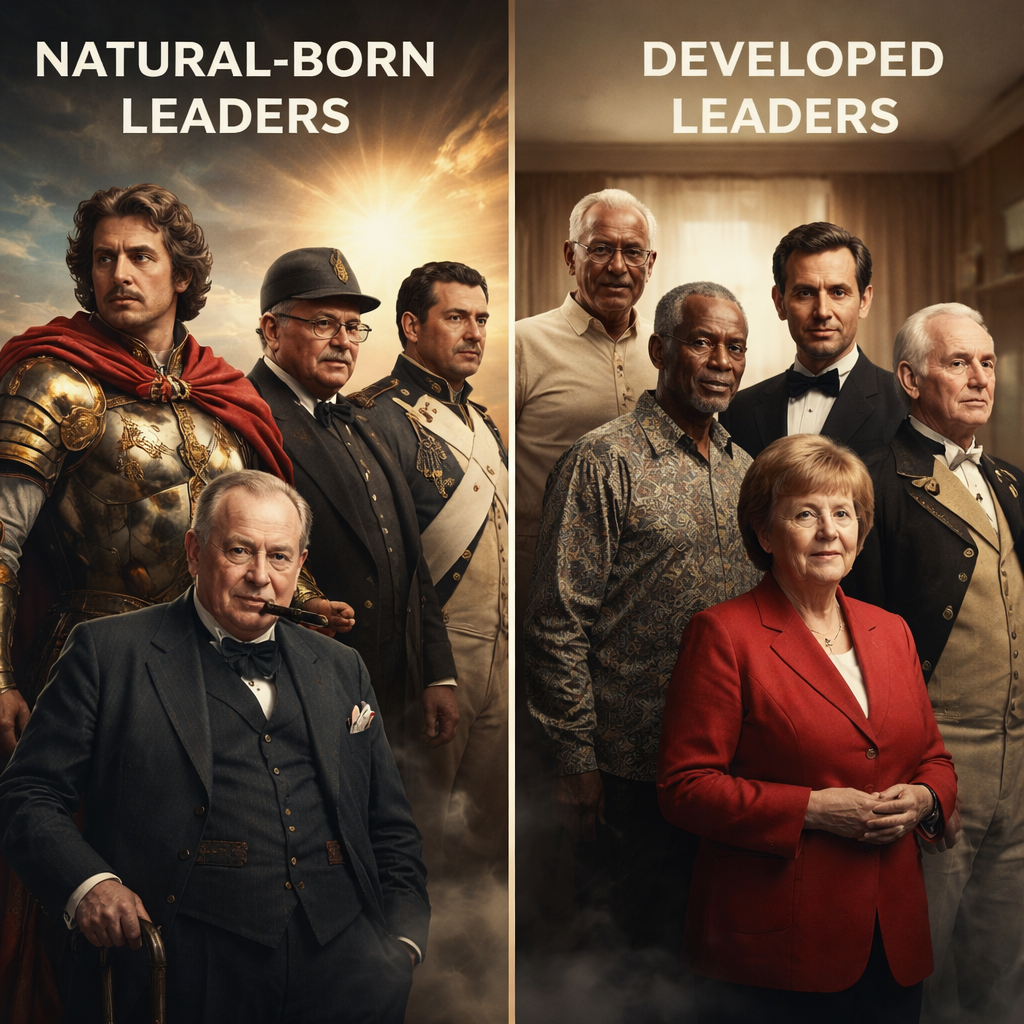
Natural‑born leaders often exhibit certain traits from childhood that set them apart. Alexander the Great demonstrated strategic thinking and the ability to inspire loyalty by age 20, when he took command of his father’s army. His natural charisma and military instincts helped him create one of history’s largest empires.
Similarly, Napoleon Bonaparte rose through military ranks during the French Revolution through sheer force of personality and strategic brilliance. His innate ambition and ability to read battlefield dynamics made him one of Europe’s most influential figures. Winston Churchill displayed natural confidence and oratory skills that helped him rally Britain during World War II, remaining calm under pressure when leadership mattered most.
But history also shows us remarkable leaders who developed their abilities over time. Abraham Lincoln started from humble beginnings and faced numerous setbacks before becoming one of America’s greatest presidents. His leadership skills emerged through persistent self‑education, political experience, and learning from failures. Lincoln’s ability to lead the nation through the Civil War came not from innate qualities but from years of developing wisdom and strategic thinking.
Nelson Mandela’s leadership journey demonstrates how resilience and learning can create extraordinary leaders. While he showed natural courage, Mandela’s true leadership abilities developed through decades of activism, imprisonment, and strategic thinking. His capacity to lead South Africa’s peaceful transition from apartheid was carefully shaped through experience and reflection, not just inborn talent.
Angela Merkel represents another powerful example of developed leadership. Originally a scientist, she methodically climbed political ranks through steady work and data‑driven decision‑making. Her leadership style, characterized by careful analysis and persistence, shows how training and experience can create highly effective leaders even without obvious natural charisma.
Research supports what these historical examples suggest. Psychology Today research indicates that leadership is roughly one‑third born and two‑thirds made. The complexity of leading organizations, military units, or nations requires such a diverse range of skills that no one could be born with everything needed.
What makes these examples particularly interesting is that even “natural‑born” leaders required development to reach their potential. Alexander the Great benefited from the education of Aristotle. Churchill’s natural speaking ability was refined through years of political experience. The raw talent provided a foundation, but achievement required building on that foundation through learning and practice.
For today’s young leaders, these historical examples offer important lessons:
- Natural advantages help, but aren’t sufficient: Even gifted leaders need to develop their skills
- Different paths lead to leadership: Some rise quickly on natural ability, others build slowly through persistence
- Context matters: The same person might be a great leader in one situation but struggle in another
- Learning never stops: All great leaders continue developing throughout their careers
The analysis of historical leadership examples reveals that the most effective leaders often combine natural talents with learned skills. They might start with certain genetic predispositions but achieve greatness through deliberate development of additional competencies.
This historical perspective should encourage young people who don’t feel like “natural” leaders. Lincoln’s early failures, Mandela’s long journey, and Merkel’s methodical rise all show that leadership can be developed through commitment and the right opportunities. The question isn’t whether you’re born to lead, but whether you’re willing to develop the skills that leadership requires.
The Modern Consensus: Why It’s Both Nature and Nurture
After decades of research and debate, scientists and leadership experts have reached a clear consensus on whether leadership is born or made: it’s both. The most comprehensive studies consistently show that effective leadership emerges from the interaction between genetic predispositions and environmental development.
Twin studies provide some of the strongest evidence for this balanced view. By comparing identical twins raised in different environments with fraternal twins raised together, researchers can separate genetic influences from environmental ones. These studies consistently find that about 25‑30% of leadership ability comes from inherited traits, while 70‑75% develops through experience, training, and environmental factors.
This research helps explain why the “Is leadership born or made?” question has persisted for so long. Both sides have been partially right. Some people do inherit traits that make leadership easier, but the majority of leadership capability comes from learned skills and developed competencies.
Modern neuroscience adds another layer to our understanding. Brain imaging studies show that leadership‑related neural pathways can be strengthened through practice and experience. This means that even if someone doesn’t start with an optimal brain structure for leadership, they can literally rewire their brain through deliberate development efforts.
The interaction between nature and nurture creates several important implications for aspiring leaders:
- Genetic advantages provide a head start, not a guarantee: Natural traits need development to become effective leadership
- Environmental factors can overcome genetic limitations: With enough development, anyone can become an effective leader
- Different genetic profiles lead to different leadership styles: There’s no single “right” way to lead
- Optimal development requires understanding both components: Know your natural strengths and work on areas that need improvement.
For college students and young professionals, this understanding offers a practical roadmap. Instead of worrying about whether you’re a “natural” leader, focus on identifying your existing strengths and systematically developing areas where you want to improve.
Consider how this applies to common leadership challenges. Someone with natural extraversion might find it easy to speak up in meetings, but needs to develop listening skills. An introverted person might excel at one‑on‑one mentoring but needs practice with public speaking. Both can become excellent leaders by building on their natural foundation while addressing their development areas.
The modern consensus also explains why leadership development programs work best when they’re personalized. Building a standout resume requires understanding both your natural strengths and learned skills, then presenting them in ways that demonstrate leadership potential.
Research institutions continue refining our understanding of how nature and nurture interact in leadership development. The most recent studies suggest that environmental factors may be even more important than previously thought, especially in complex modern organizations where leadership requires diverse skills and adaptability.
This evolving understanding should encourage anyone who wants to develop leadership abilities. While genetic predispositions matter, they’re just the starting point. The majority of what makes someone an effective leader can be learned, practiced, and improved throughout their career.
Frequently Asked Questions
Can someone with no natural leadership traits become an effective leader?
Absolutely. Research shows that 70‑75% of leadership ability comes from learned skills rather than inherited traits. While natural advantages can provide a head start, anyone can develop effective leadership through deliberate practice, coaching, and experience. Many successful leaders, including Abraham Lincoln and Angela Merkel, developed their abilities over time rather than displaying obvious natural talent from the beginning. The key is identifying your existing strengths and systematically building additional competencies through training and real‑world practice.
What genetic traits are most associated with natural leadership ability?
Studies have identified several genetic factors linked to leadership potential, including the rs4950 genotype discovered by University College London researchers. Natural leadership traits include extraversion, emotional regulation, social intelligence, and confidence under pressure. However, these genetic predispositions only account for about 25‑30% of leadership effectiveness. Even people with these natural advantages need to develop their skills through experience and training to become truly effective leaders in complex organizational environments.
How can young people develop leadership skills without formal authority?
Leadership development doesn’t require a title or formal position. Students can build skills by organizing study groups, coordinating volunteer activities, leading class projects, or starting campus clubs. The key is seeking opportunities to influence, motivate, and guide others toward common goals. Practice active listening, give constructive feedback, and take initiative in group settings. These experiences provide valuable leadership practice while demonstrating your potential to future employers or graduate programs.
Is leadership born or made in different cultural contexts?
Cultural context significantly influences how leadership develops and is expressed. Some cultures emphasize collective decision‑making and consensus‑building, while others value more hierarchical, directive leadership styles. However, the basic principle remains the same across cultures: leadership emerges from both natural traits and environmental development. What changes is which specific behaviors are valued and how leadership skills are cultivated within different cultural frameworks and organizational structures.
Can introverted people become effective leaders?
Introverted individuals can absolutely become exceptional leaders. While they might approach leadership differently than extraverts, introverted leaders often excel at listening, thoughtful decision‑making, and one‑on‑one mentoring. They tend to be more deliberate in their communication and may prefer leading through expertise and quiet influence rather than charismatic speeches. Many successful leaders, including Bill Gates and Warren Buffett, demonstrate that introversion can be a leadership strength when properly developed and applied.
What’s the best way to identify your natural leadership strengths?
Start by reflecting on situations where you naturally took charge, or others looked to you for guidance. Ask friends, family, and colleagues what leadership qualities they see in you. Take personality assessments that identify your natural communication style, decision‑making preferences, and social tendencies. Pay attention to which leadership activities energize you versus drain you. Consider working with a mentor or coach who can help you recognize patterns and strengths you might not see in yourself.
How long does it take to develop effective leadership skills?
Leadership development is an ongoing process rather than a destination. Basic leadership competencies can be developed within months through focused practice and feedback, but mastery takes years of experience across different situations and challenges. Most leadership experts suggest that meaningful skill development requires consistent practice over 2‑3 years, with continued refinement throughout your career. The timeline depends on your starting point, the intensity of your development efforts, and the complexity of the leadership contexts you’re preparing for.
Should parents try to develop leadership skills in their children?
Parents can absolutely support leadership development by modeling effective leadership behaviors, encouraging children to take age‑appropriate responsibility, and providing opportunities for them to practice influence and decision‑making. However, the approach should focus on developing core competencies like communication, problem‑solving, and empathy rather than pushing children into leadership roles they’re not ready for. Understanding academic pressure is important because forced leadership development can create stress rather than genuine skill building.
Conclusion
The age‑old question “is leadership born or made?” finally has a science‑backed answer: it’s both, but the scales tip heavily toward development. While genetic factors account for roughly 25‑30% of leadership ability, the remaining 70‑75% comes from learned skills, environmental influences, and deliberate practice.
This research should encourage every young person who’s ever wondered about their leadership potential. You don’t need to be born with natural charisma or confidence to become an effective leader. History shows us that some of the most impactful leaders, from Abraham Lincoln to Nelson Mandela, developed their abilities through persistence, learning from failure, and commitment to growth.
The key insights for aspiring leaders are clear: understand your natural strengths, but don’t let them limit your development. Seek out coaching and mentoring opportunities that challenge you to grow. Practice leadership in low‑stakes environments like study groups, volunteer organizations, or campus clubs. Most importantly, remember that leadership development is a lifelong journey, not a destination.
For Gen Z students and young professionals, this understanding opens up tremendous possibilities. Instead of waiting for someone to recognize your “natural” leadership ability, you can actively develop the skills that matter most in your field and context. Whether you’re naturally extraverted or introverted, detail‑oriented or big‑picture focused, you can build on your existing foundation to become the kind of leader your community needs.
The modern consensus on leadership development emphasizes personalized approaches that honor both your genetic starting point and your environmental influences. By understanding how your early experiences shaped your leadership instincts, you can consciously choose which patterns to keep and which to modify as you grow.
As you move forward in your leadership journey, remember that the question isn’t whether you’re born to lead, but whether you’re committed to developing the skills that leadership requires. With the right combination of self‑awareness, deliberate practice, and ongoing learning, anyone can become an effective leader who makes a positive impact on their organization and community.