
How to Build Self-Confidence

How to Build Self-Confidence
Ever felt that knot in your stomach right before you speak up in class, or that little voice that says you’re not enough when you scroll through socials? Yeah, I’ve been there too – that uneasy mix of doubt and curiosity about how to actually feel confident.
Here’s the thing: confidence isn’t some magical trait you’re either born with or not. It’s a muscle you can flex, a habit you can practice, and a mindset you can reshape. Think of it like learning to ride a bike – the first wobble is scary, but each push on the pedals makes the ride smoother.
First, notice the moments when you’re holding back. Maybe it’s turning down a group project because you fear you’ll mess up, or avoiding a date because you think you’ll say the wrong thing. Write those scenarios down. Seeing them on paper turns a vague feeling into a concrete target you can work on.
Next, celebrate tiny wins. Did you answer one question in a lecture? That’s a win. Did you post a story about a hobby you love? That’s another. Over time, accumulating these micro-victories builds a solid foundation of self-esteem.
Another practical step is to reframe self‑talk. Instead of “I’m terrible at this,” try “I’m learning how to improve.” It sounds simple, but research shows that positive self‑talk can boost performance by up to 15% in academic settings.
If peer pressure is chipping away at your confidence, check out our guide on Coping with Peer Pressure: How to Protect Your Self‑Esteem. It offers concrete techniques that help you stay true to yourself while still fitting in when you want to.
Also, create a “confidence toolkit.” Include things like a playlist that pumps you up, a journal for tracking progress, and a list of supportive friends you can call when doubt creeps in. Having tangible resources makes the process feel less abstract.
Finally, practice exposure. Set a small, achievable challenge each week – maybe speaking up in a small group, or striking up a conversation with a stranger. The more you step out of your comfort zone, the more your confidence expands, because you prove to yourself that you can handle the discomfort.
So, what’s the next move? Grab a notebook, list one confidence‑building action you can try today, and give it a go. You’ll be surprised how quickly those small steps add up to big change.
TL;DR
If you’re ready to swap self‑doubt for daily confidence, start noticing those tiny wins, reframe your inner chatter, and practice small, brave steps each week.
In just a few minutes a day, you’ll build a confidence toolkit that fuels motivation, eases anxiety, and shows you truly can own any situation.
Step 1: Identify Your Confidence Triggers
Alright, let’s start with the part that feels a bit messy but is actually the goldmine: spotting what pulls your confidence down. You might think “I’m just nervous all the time,” but dig a little deeper and you’ll notice patterns – a certain class, a social media scroll, maybe the moment you have to speak up in a group.
Grab a notebook or open a notes app on your phone. The next time you feel that knot in your stomach, jot down three things: what you were doing, who was around, and what thought popped up. It doesn’t have to be fancy; a quick bullet works.
Why does this matter? Because once you have a list, you can see the repeat offenders. Maybe it’s “presentations in front of the whole class” or “sending a DM to someone you like.” Recognising the trigger is the first step in taking control, not letting the feeling surprise you.
Think about it this way: each trigger is like a loose screw on a bike. If you ignore it, the ride stays wobbly. Tighten it, and the whole thing feels smoother. So treat your notes like a maintenance log.
Look for the hidden cues.
Sometimes the trigger isn’t obvious. You could feel a dip in confidence after scrolling through Instagram, even if you weren’t actively comparing yourself. Or you might notice a drop after a “bad” grade, even if the grade itself was decent. The brain ties the emotion to the event.
Ask yourself: “What was I thinking right before the doubt crept in?” Write down the exact thought, even if it sounds silly. “I’m going to mess up” becomes a data point you can later re‑frame.
For many of our readers, anxiety is the silent partner. If you need a quick way to calm that nervous energy, check out 5 Practical Strategies to Manage Anxiety at School and in Social Situations. Those tips can help you pause before the trigger hits.
Turn triggers into visual cues.
Now, here’s a trick that feels a bit like a productivity hack but works wonders for confidence: use a visual progress tracker. You can draw a simple chart on a wall, colour‑code days you faced a trigger, and mark whether you handled it well. Seeing the pattern visually makes the abstract feel concrete.
One guide that walks you through setting up that kind of tracker is the visual progress tracker for sessions. It shows how a quick visual cue can boost motivation and give you a tangible sense of progress.
When you look at the chart at the end of the week, you’ll notice “I survived three presentation moments” or “I limited Instagram scrolling to 30 minutes.” Those little wins stack up and start rewiring your brain to expect success.
Make it a habit
Set a reminder on your phone—maybe every night at 10 p.m.—to fill in your trigger log. It only takes a minute, but consistency turns a one‑off note into a habit. Over a month, you’ll have a mini‑database you can review.
During review, ask: “Which triggers showed up most?” and “What did I do that helped?” Write a short action plan for the top three. For example, if “group projects” are a trigger, plan to speak up with one prepared comment.
And remember, you’re not alone in this. Many Gen Zers, college students, and young adults wrestle with the same invisible pressures. By mapping them out, you’re already ahead of the game.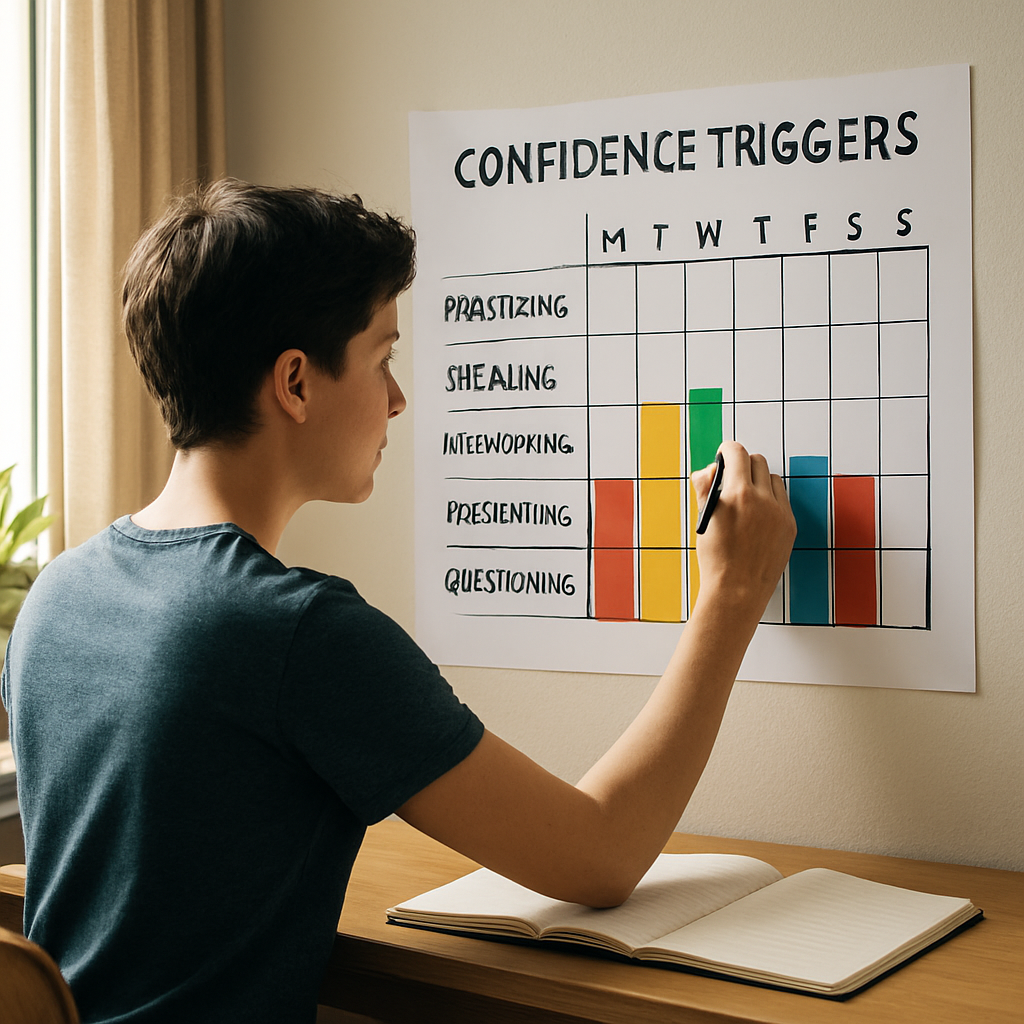
Step 2: Set Small, Achievable Goals
Okay, you’ve got your trigger list in front of you. The next move is to turn those vague “I should be braver” thoughts into bite‑sized missions you can actually finish. Small, achievable goals are the secret sauce that turns self‑doubt into a steady stream of wins.
Why tiny goals work
Psychologists call this “self‑efficacy” – the belief that you can handle a task. When you nail a modest target, your brain files that success as proof you’re capable. A study summarized by The Mental Game Clinic shows that people who set realistic milestones report a 15‑20% boost in confidence after just two weeks.
So instead of saying “I’ll never speak up in class,” try “I’ll share one sentence in tomorrow’s discussion.” The goal feels doable, the pressure stays low, and the payoff – a tiny confidence spike – is real.
Step‑by‑step blueprint
1. Pick a focus area. It could be speaking up, finishing a homework assignment early, or sending a friendly DM to a classmate. Choose something that nudges your comfort zone without pulling you into a panic.
2. Break it into three tiers. Minimum Goal – the absolute easiest version (write one sentence). Target Goal – a modest stretch (share two thoughts). Stretch Goal – the “if I’m on fire” version (lead a short discussion). This tiered system keeps you from over‑promising yourself.
3. Schedule it. Put the minimum and target goals on your calendar, not just your to‑do list. A 10‑minute block on Monday evening to rehearse a two‑sentence intro works better than a vague “someday I’ll try.”
4. Prep the “what if.” Ask yourself, “What could go wrong?” Then write a quick backup plan. If you stumble on your sentence, you can simply pause, smile, and add a follow‑up. Having a plan removes the mystery that fuels anxiety.
5. Celebrate the micro‑win. When you hit the minimum goal, give yourself a tiny reward – a favorite snack, a quick scroll through a meme page, or a high‑five to your reflection. The celebration creates a positive feedback loop that tells your brain, “Hey, this works.”
Real‑world snapshots
Meet Sam, a first‑year university student who freezes whenever a professor calls on him. He set a minimum goal of “make eye contact and say ‘yes’” during the next lab. The target was “add one comment about the experiment.” After a week of practicing, Sam hit his target twice and felt a genuine lift in confidence. He’s now eyeing a stretch goal: lead a short presentation next month.
Another example: Maya wants to be more active on Instagram, but the fear of “looking weird” holds her back. She started with a minimum goal of posting a single photo of her coffee mug. The target goal was a short caption about her morning routine. Within three days, she celebrated both wins and now plans a stretch goal of a 30‑second video tour of her study space. Each step feels manageable, so the anxiety shrinks.
Tips to keep the momentum
• Batch similar goals. If you’re working on public speaking, bundle all practice sessions into one week. Consistency beats randomness.
• Use a focus boost. Some of our readers find a gentle focus supplement helpful during study blocks. While we don’t endorse any specific brand, a modest caffeine‑free option can keep the mind sharp for those short goal‑sessions.
• Use a visual tracker. A simple habit‑tracker grid (✔️) lets you see streaks grow. Seeing a column of green checkmarks is surprisingly motivating.
For a quick cheat sheet on how to turn a big ambition into tiny, trackable actions, check out our guide on building a standout resume with little to no work experience. The same principle applies: break the resume into sections, conquer one bullet point at a time, and watch confidence stack up.
Quick checklist
- Choose one confidence‑building area for this week.
- Write a minimum, target, and stretch goal for that area.
- Block a specific time slot on your calendar.
- Prepare a backup plan for possible hiccups.
- Celebrate each completed goal with a micro‑reward.
Remember, confidence isn’t a single giant leap; it’s a series of tiny steps that add up. By setting small, achievable goals, you give yourself proof that you can succeed – and that proof becomes the foundation of lasting self‑confidence.
Step 3: Practice Positive Self‑Talk and Visualization
Okay, you’ve already spotted the triggers that knock your confidence off‑balance, and you’ve set tiny, doable goals. Now it’s time to rewrite the inner dialogue that’s been holding you back and picture the version of you that already owns the room.
Ever notice how a quick “I can do this” feels a lot lighter than a lingering “What if I mess up?”? That tiny shift is the core of positive self‑talk, and it’s something you can train just like a muscle.
Why positive self‑talk matters
Research from Verywell Mind shows that optimistic self‑talk can boost performance by up to 15 % in academic settings. In plain English, swapping “I’m terrible at presentations” for “I’m getting better each time I speak” actually changes how your brain fires, making you calmer and more focused.
And the good news? You don’t need a therapist on call for every sentence – you just need a few reliable habits.
Three‑step self‑talk formula
1. Catch the negative script. When you feel that knot in your stomach, pause. Write down the exact thought – it might be “I’ll sound dumb.”
2. Reframe with evidence. Ask yourself, “Do I have proof I’m dumb?” Probably not. Replace it with a fact: “I’ve prepared the key points, and I’ve spoken up before.”
3. Anchor the new line. Turn the fact into a short mantra you can repeat, like “I’m prepared, I’m capable.” Say it out loud a couple of times before the next confidence‑testing moment.
Does that sound doable? It does for Maya, a sophomore who used to freeze during lab discussions. She started noting each negative thought, swapped it for a concrete fact (“I read the lab manual”), and whispered her mantra. Within a week, she raised her hand twice – a win she now celebrates with a latte.
Visualization: seeing the future you want
Visualization is like a mental rehearsal. Athletes use it, actors use it, and you can too. The trick is to make the scene vivid: see the room, hear the murmurs, feel the texture of the microphone, and notice the confidence radiating from you.
Here’s a quick how‑to:
- Find a quiet spot and close your eyes.
- Picture a specific upcoming situation – a class discussion, a networking event, a video call.
- Imagine yourself speaking clearly, smiling, and receiving positive nods.
- Stay in that image for 30‑60 seconds, engaging all senses.
Do this once a day for a week, and you’ll notice a subtle shift from “what if” to “I’m already there.”
Want a deeper dive on how external influences shape the way you talk to yourself? Check out our guide on understanding the impact of social media on self‑esteem. It explains why scrolling can amplify self‑criticism and how to flip that script.
Practical checklist for today
- Identify one negative thought that pops up during a confidence‑challenging moment.
- Write a fact‑based counterstatement.
- Create a 5‑word mantra and repeat it twice before the next event.
- Spend 45 seconds visualizing yourself succeeding in that event.
It may feel a little odd at first – like you’re rehearsing a movie in your head – but the brain doesn’t care if it’s real or imagined. It treats the rehearsal as experience, building neural pathways that make the actual performance feel familiar.
Quick comparison table
| Technique | How to start | Key benefit |
|---|---|---|
| Positive self‑talk | Write down a negative thought, replace with evidence‑based mantra | Reduces anxiety, boosts confidence by up to 15 % |
| Visualization | Spend 30‑60 seconds picturing a successful outcome | Creates mental rehearsal, improves performance |
| Micro‑mantra | Craft a 5‑word phrase and repeat before the task | Quick confidence cue, easy to recall |
Give these steps a try tomorrow. You might stumble, you might feel a little goofy – that’s totally normal. The point is you’re training your brain to expect success rather than failure. And every time you do, you’re adding another brick to that confidence wall you’ve been building piece by piece.
Step 4: Build a Supportive Routine
Now that you’ve spotted triggers and set bite‑size goals, the next piece of the puzzle is turning those intentions into a daily rhythm that actually shows up.
Research from Psychology Today notes that habit‑building practices can boost confidence by up to 15 % when you repeat them for just 21 days, because your brain starts to treat the behavior as “normal” instead of “extra effort.”
Here’s how to stitch a supportive routine that feels doable for a busy college student or a young professional.
Pick a Consistent Anchor Time
Choose one anchor point in your day – maybe the first thing after you wake up or the moment you sit down to study. Write down a tiny confidence cue at that moment, like “I’m ready to own this hour.” By pairing the cue with an existing habit (brushing teeth, making coffee), you create an automatic trigger.
Stack Micro‑Habits
Instead of overhauling your entire schedule, stack micro‑habits onto things you already do. After you finish a lecture, spend two minutes reviewing one win from that class. After you log into your laptop, open a gratitude note. Each micro‑habit takes less than five minutes, so you won’t feel overwhelmed.
Move Your Body
Physical movement is a confidence booster. A 10‑minute walk, a quick stretch, or a short body‑weight circuit releases dopamine and endorphins, which research links to higher self‑esteem. If you’re crunched for time, try a “movement burst” between Zoom sessions – 20 seconds of jumping jacks, then back to work.
Mindful Reset
Insert a 3‑minute mindfulness pause mid‑day. Sit upright, close your eyes, and breathe 4‑7‑8. Notice any self‑critical thoughts, label them (“I’m thinking I’m not good enough”), and let them drift. This tiny reset lowers anxiety and keeps your confidence “buffer” intact.
Fuel Your Brain
Nutrition matters, too. A balanced snack of protein and fruit steadies blood sugar, preventing the “crash” that often fuels self‑doubt. Some readers find a modest dose of focus‑enhancing nootropics helpful – Great Bite Supplements offers gummy options that many college students use to stay sharp without caffeine spikes.
Let’s look at a real‑world example. Maya, a second‑year student, set her anchor at 8 am after making coffee. She spends 2 minutes reciting a personal mantra, then writes one micro‑win from the previous day. Mid‑day, she does a 5‑minute walk to the campus garden, followed by a quick gratitude jot‑down. By two weeks, she reported feeling “more in control,” and her class participation rose from 0 to 3 times per week.
Another case: Jamal, who works part‑time at a coffee shop, uses his break after the morning rush to do a 3‑minute breathing exercise and then reads a single tip from our Boost Your Focus: Proven Techniques for More Effective Studying guide. The focused tip reminds him to set a clear intention for the next shift, which reduces his self‑critical chatter about “messing up orders.”
To keep the routine sustainable, treat it like a flexible contract with yourself. If a day throws a curveball, shift the anchor – maybe do the mantra during a lunch break instead of morning. The goal isn’t perfection; it’s consistency over time.
Your Daily Confidence Routine Checklist
- Pick a single anchor time (morning coffee, post‑lecture).
- Write a 5‑word confidence cue and repeat it.
- Add one micro‑habit (gratitude note, win log).
- Move your body for at least 10 minutes.
- Take a 3‑minute mindful breath pause.
- Fuel with a protein‑rich snack; consider a focus gummy if you like.
Start small, track what works, and adjust. In a month, you’ll have a personal routine that feels as natural as checking your phone – and every time you follow it, you’re reinforcing the belief that you can rely on yourself.
Step 5: Seek Feedback and Celebrate Progress
Now that you’ve got a routine humming, the next game‑changer is getting honest feedback and actually patting yourself on the back.
Why feedback matters more than you think
Feedback is like a mirror that shows the parts of you that are already working – and the parts that still need a tweak.
Studies in social‑psychology tell us that people who receive regular, specific praise are up to 20 % more likely to stick with a new habit.
In our experience at Questions Young People Ask, the teens who ask for quick “what‑went‑well?” notes after a presentation often report a noticeable confidence jump within a week.
Step‑by‑step: Ask for the right kind of feedback
1. Pick a trusted micro‑audience. That could be a study buddy, a roommate, or a professor you vibe with. Choose someone who’ll be honest but encouraging.
2. Use a simple feedback prompt. Instead of “Did I do okay?” ask “What’s one thing I did that felt strong, and one tiny thing I could sharpen?” This keeps the response actionable.
3. Record it. Jot the comment in a dedicated “Feedback Log” right after you get it. Seeing the same positive phrase appear three times turns it into evidence you can trust.
4. Reflect within 24 hours. Ask yourself, “How does this line up with what I felt?” If the feedback feels off, you’ve uncovered a blind spot to explore.
Real‑world snapshot
Take Maya, a second‑year art student. She asked her critique partner, “What’s one detail in my portfolio that makes me feel confident?” The partner pointed out her bold colour choices. Maya wrote that note, celebrated it with a quick doodle, and later that week, she submitted a gallery application, feeling genuinely proud.
Jamal, who works evenings at a coffee shop, started asking his manager, “What’s one thing I handled well during the rush?” The manager highlighted his calm tone when the line grew long. Jamal logged that, gave himself a five‑minute “win walk” after his shift, and his self‑rating on confidence rose from 3 to 7 over two weeks.
Celebrate progress – don’t wait for the big win.
Confidence builds on tiny victories. When you notice a pattern of praise, turn it into a mini‑celebration ritual. That could be as simple as a favourite snack, a 30‑second dance, or sharing the win on a private chat with friends.
Research from the LinkedIn post on positive feedback shows that people who consciously “savour” compliments experience a measurable boost in self‑esteem (see how positive feedback fuels confidence).
Here’s a quick celebration checklist you can copy‑paste:
- Read the feedback aloud.
- Mark it with a ✅ in your Feedback Log.
- Do a 1‑minute “confidence dance” or stretch.
- Reward yourself with a small treat you love.
- Write a one‑sentence note: “I earned this because…”
Integrate feedback into your routine.
Pair the feedback moment with an existing habit. For example, after your evening study session, spend two minutes reviewing the day’s feedback before you shut down your laptop. The habit stack makes the practice stick without feeling like extra work.
Another tip: set a weekly “feedback hour.” Block 15 minutes on Sunday to scan your log, look for recurring themes, and decide on one micro‑adjustment for the coming week – maybe speaking a second sentence in class or asking a clarifying question in a meeting.
Final thought
Seeking feedback and celebrating progress turns confidence from a vague feeling into a concrete habit. It’s the missing piece that bridges your routine (Step 4) with lasting self‑belief. So, grab that notebook, ask a trusted friend for one specific compliment, and give yourself a mini‑high‑five. You’ll be surprised how quickly “how to build self-confidence” stops sounding like a question and starts feeling like a reality you’re already living.
FAQ
Got questions about how to build self-confidence? Below are the most common concerns we hear from Gen Z students, plus practical answers you can start using today.
How can I start building self-confidence if I feel completely stuck?
First, notice the exact moment you feel the knot – maybe it’s right before you raise a hand in class. Write that trigger down in a simple notebook. Then pick one tiny action you can actually do, like saying “I’ve got one idea” instead of staying silent. Celebrate that micro‑win with a quick high‑five or a favorite snack. Repeating this loop turns a vague fear into concrete evidence that you can act.
What daily habit helps boost confidence for college students and young adults?
A 2‑minute “win review” right after your last lecture works wonders. Grab your phone or a paper, and list the three things that went well that day – even something as small as answering a chat question. Next, write a one‑sentence “I earned this because…” note. Over a week, you’ll see patterns of strength, and the habit trains your brain to look for success first.
Why does positive feedback matter, and how should I use it?
Positive feedback acts like a mirror that shows you what’s already working. Ask a trusted friend or a professor for one specific compliment after you finish a project. Record the exact words in a “Feedback Log” and read them aloud before a stressful task. The repetition creates a mental cue that says, “I’ve done this before, I can do it again.”
How do I silence self‑doubt right before a presentation or meeting?
Use the 4‑7‑8 breathing trick: inhale for four seconds, hold for seven, exhale for eight. While you breathe, replace the negative script (“I’ll mess up”) with a fact (“I prepared three key points”). Then whisper a short mantra like “I’m ready, I’m clear.” Practice this in the bathroom stall or hallway – the body learns the routine faster than the mind.
Can I improve my confidence without spending a lot of time each day?
Absolutely. Tiny micro‑actions add up. For example, set a phone reminder that says “Stand tall, smile” at lunch. When the alert pops, straighten your posture for ten seconds and think of one recent win. It only takes a few seconds, but the posture boost releases confidence‑supporting hormones and reminds you of your progress. You can also pair the reminder with a quick gratitude note, like “I’m proud of finishing my homework,” to lock in the confidence boost.
What role does mindset play in how to build self confidence?
Mindset is the lens you use to interpret every experience. Shift from a fixed view, “I’m not good at talking,” to a growth view, “I’m getting better each time I speak.” Whenever a setback pops up, ask yourself, “What can I learn?” Write down one lesson. Over weeks, the habit rewires your inner dialogue, making confidence feel like a skill you’re actively sharpening.
Conclusion
We’ve walked through everything from spotting triggers to celebrating tiny wins, and you’re now sitting with a toolbox that actually works.
So, what’s the next move? Pick one micro‑goal from the list – maybe a five‑second posture check at lunch – and try it today. The moment you notice yourself doing it, give yourself a quick mental high‑five. That tiny acknowledgment is the secret sauce that keeps the habit alive.
Remember, building confidence isn’t a marathon you run once a month; it’s a series of short, repeatable actions you sprinkle into everyday life. Each time you catch a negative script, replace it with a fact, and you’re rewiring the brain to expect success.
And if you ever feel the knot return, go back to the simple mantra we practiced: “I’m prepared, I’m capable.” Say it aloud, breathe 4‑7‑8, and watch the tension melt. You’ve already proved you can follow a routine, so trust that you can master this too.
Finally, keep the momentum going by writing down one confidence‑building win before you head to bed. Tomorrow you’ll wake up with proof that you’re already moving forward.
Ready to own every room, class, or conversation? The steps are right here – all you need is the willingness to start.





1 thought on “How to Build Self-Confidence”